

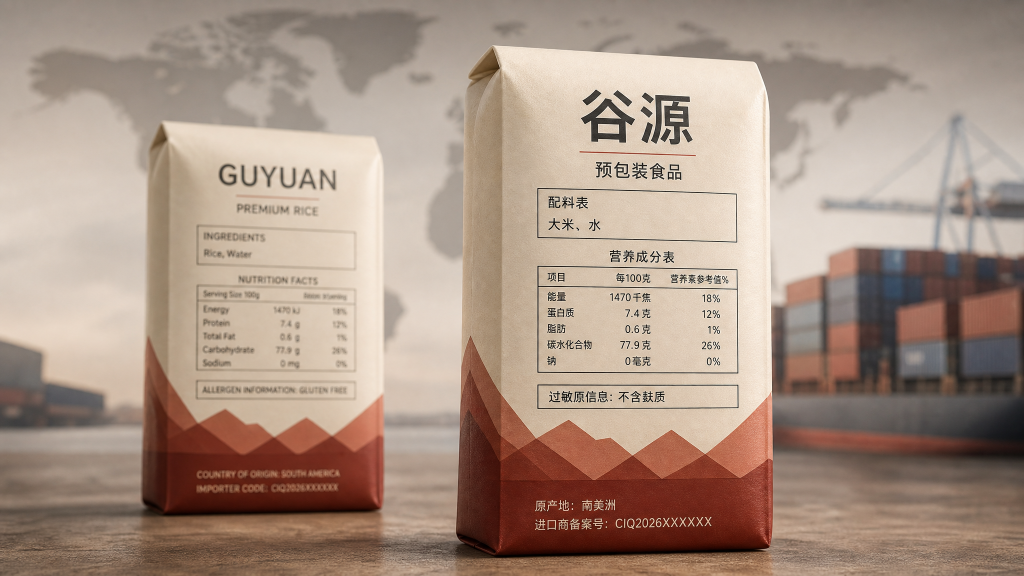
China doesn’t use warning seals or traffic-light labels: it requires a label printed in Chinese, with exact correspondence to the label in the language of origin, and a visible customs registration number on the package before the product can be sold. Today the rule in force is GB 7718-2011, but it already has an expiration date: the GB 7718-2025 reform takes effect on March 16, 2027, with saturated fat and sugars becoming mandatory nutrients for the first time.
This is the sixth installment in our series on food labeling requirements, following Colombia, Ecuador, the United States and Mexico.
What rules govern the label today, and what’s about to change
Today, a prepackaged food sold in China — domestic or imported — must comply with GB 7718-2011 (the general labeling standard) and GB 28050-2011 (nutrition labeling), both issued by the National Health Commission (NHC) and the State Administration for Market Regulation (SAMR). The underlying legal framework is the Food Safety Law of the People’s Republic of China, whose Article 71 prohibits a label from containing false content or suggesting that the food prevents or cures disease.
That’s going to change, but not yet. On March 27, 2025, the NHC and SAMR published the new GB 7718-2025 and GB 28050-2025 — which directly replace the 2011 versions — together with the Regulation on the Supervision and Administration of Food Labeling (SAMR Order 100). All three take effect on March 16, 2027. That’s a transition period of exactly two years, and anyone designing export artwork for China today has to decide whether to design it around the rule currently in force or the one that’s already known and on its way.
Oversight is split between two authorities with distinct roles: SAMR and the NHC supervise whether the label meets the technical standards; China Customs (GACC) controls the registration of the foreign plants that export to the country. That second piece — customs registration — has its own calendar, and it’s one of the points where generic export guides get it wrong most often.
What every label must carry
The list of mandatory information doesn’t vary much between the rule in force and the one arriving in 2027; what changes is the detail behind each item, covered further below. At a minimum, every label on a prepackaged food sold directly to the consumer must include:
- Name of the food, in a prominent position, reflecting its true nature.
- List of ingredients in descending order by weight, with additives identified by their generic name.
- Nutrition labeling.
- Net content and specifications (except for products sold by unit of measure).
- Name, address and contact details of the producer or operator.
- Production date and expiration date, in year-month-day order.
- Storage conditions.
- Food production license number (does not apply to imported products).
- Product standard code (also does not apply to imported products).
- Allergen warning.
All information must be truthful, understandable and based on scientific grounds: no misleading language, images or symbols are allowed, nor may the label suggest — explicitly or implicitly — that the food or any of its ingredients prevents or treats a disease. And except for registered trademarks, email addresses and websites, the label must use standardized Chinese characters.
The bilingual label and customs registration
This is what truly sets China apart from the rest of this series. In Colombia or Mexico the challenge is finding room for an octagonal seal; in China the challenge is making sure two labels — the original and the Chinese one — say exactly the same thing.
The standard calls it exact correspondence: all the mandatory information that appears on the Chinese label must match, item for item, the information on the label in the foreign language. And if there’s something Chinese law requires to be declared that isn’t on the original label — an allergen, for example — it has to be added to the Chinese version anyway, even if the manufacturer of origin doesn’t declare it in its own market. It isn’t a free translation; it’s a mirror declaration.
The imported label must also carry:
- Name, address and contact details of the importer or distributor in China.
- The foreign manufacturer’s registration number with the Chinese authority, or the number approved by the competent authority in the country of origin. This is the data point that links the label to customs registration: every foreign food manufacturer, processor or warehouse must be registered with China Customs (GACC) before it can export, and that number has to appear on both the inner and outer packaging.
- Country or region of origin — the criterion is where the product’s final substantial change took place.
- Production date: if the original packaging doesn’t carry it, it’s calculated from the shelf life and added to the Chinese label.
In exchange, imported products get a real exemption: they don’t need the Chinese production license number or the product standard code — the two fields that are only required for food manufactured domestically.
Allergens, additives and the claims that can no longer be used the same way
China requires declaring eight allergen categories when used as ingredients: gluten-containing cereals and their derivatives (wheat, rye, barley, oats, spelt or their hybrids), crustaceans, fish, eggs, peanuts, soybeans, milk and dairy products — including lactose — and tree nuts. The warning goes in the ingredient list or near it, and the standard recommends — though doesn’t always require — also warning about the risk of cross-contamination when production lines are shared.
Additives are labeled with their generic name, per the GB 2760 and GB 14880 standards; on packages with a maximum surface area of 60 cm² or less, the international number (INS) may be used instead.
The change that matters most to a brand that already sells under a “clean label” claim in other markets: the terms “no added” or “does not use” — and their synonyms — can only be used if the content of that ingredient is literally zero. A product with trace amounts of sugar below the threshold that would require declaring it in other countries cannot say “no added sugar” in China if it technically contains any. And if an ingredient is highlighted in the product name or in an image on the package, its added amount or content in the final product must be declared.
Nutrition labeling: what GB 28050 requires
The nutrition labeling standard was also rewritten on the same date, March 27, 2025, with the same effective date: March 16, 2027.
Today, under GB 28050-2011, the mandatory nutrients are energy, protein, fat, carbohydrates and sodium. GB 28050-2025 adds two: saturated fat and sugars become mandatory, each with its percentage of the Nutrient Reference Value (%NRV). And a new legend appears, mandatory with no exceptions, in Chinese: a warning aimed at children and adolescents about excessive consumption of salt, oil and sugar. It isn’t a graphic icon like the Colombian or Mexican octagon — it’s text — but it serves a similar function: it forces the nutritional risk conversation directly onto the front of the package.
The size-based exemption also changes, in the direction of more leeway: packages with a maximum surface area of up to 40 cm² are now exempt from nutrition labeling, up from the current threshold of 20 cm² (or 100 cm² total surface area). For special dietary foods, the reference standard remains GB 13432.
The digital label
The digital label doesn’t exist under the 2011 standard; it’s introduced by the 2025 reform. It’s food information displayed through digital means — a QR code, for example — directly on the package.
It has a clear limit: it complements, but does not replace, the mandatory information on the physical package. The only exception is food that isn’t delivered directly to the end consumer — B2B sales — where it may carry information that isn’t on the physical packaging. When used, it must be explicitly identified as a “digital label” and its content must be consistent with what’s printed on the package.
The double clock: 2026 and 2027
There are two dates a China exporter needs on the calendar, and they aren’t the same.
June 1, 2026 — customs registration changes. Until then, the registration of foreign food manufacturers with China Customs was governed by GACC Decree 248. As of that date, Decree 280 takes effect and replaces it: it introduces two registration pathways and three risk-level categories, a catalog of 17 food categories under “recommended registration,” and new mandatory fields on the customs declaration. Registrations already in force under Decree 248 remain valid, with no need to reapply. (This point was verified against analysis from consultancies specializing in foreign trade with China — not against GACC’s official text in Chinese — and it’s worth confirming with a customs broker before closing a shipment under the new regime.)
March 16, 2027 — the rewritten labeling standards take effect. GB 7718-2025, GB 28050-2025 and the SAMR Labeling Regulation, all on the same date.
In the meantime, non-compliance with the current standard already carries a cost: Article 125 of China’s Food Safety Law imposes a fine of 5,000 to 50,000 RMB when the value of the goods sold is under 10,000 RMB, or five to ten times that value when it exceeds it — in addition to confiscation of the goods produced or sold — and in the most serious cases can lead to a production suspension or license revocation. A minor defect that doesn’t affect safety or mislead is resolved with a correction order; if the company refuses to correct it, the fine is up to 2,000 RMB. SAMR Order 100 adds specific penalties for particular cases, such as improperly using “special supply” claims intended for state or military bodies.
China versus Colombia, Ecuador, the United States and Mexico
| China | Colombia | Ecuador | United States | Mexico | |
|---|---|---|---|---|---|
| Front-of-pack warning | None today; text legend on salt/oil/sugar from 2027 | Black octagon | Traffic-light bars | None in force; front-of-pack rule proposed, not finalized | Black octagon |
| Language required | Chinese, with exact correspondence to the language of origin | Spanish | Spanish | English | Spanish |
| Who enforces labeling | SAMR and NHC | Invima | ARCSA | FDA / USDA-FSIS | PROFECO and COFEPRIS |
| What’s unique to this market | Customs registration number (GACC) printed on the package | “MINSALUD” signature seal and declaration tolerances | Traffic-light system in force since 2014, no migration to octagons | Nutrition Facts panel + bioengineered food disclosure | Unique numeric seal on faces ≤ 40 cm² |
China is the only one of the five markets with no graphic front-of-pack warning seal. It’s also the only one that makes sale conditional on a prior customs procedure: without the GACC registration number on the package, the product cannot enter the country, no matter how well the rest of the label is executed. For the US side of the comparison, see our guide to US food labeling requirements for 2026 and 2027.
What it means for packaging
Three concrete decisions for anyone designing or printing export packaging for China.
The artwork is no longer just one file. Translating the original label isn’t enough: a Chinese version has to be built that says exactly the same thing, including any declaration Chinese law requires that the manufacturer doesn’t include by default. That means coordinating two artworks that have to stay in sync every time the formula or an ingredient supplier changes.
Space has to be reserved for the registration number. The manufacturer’s GACC registration number — or the one approved by the authority in the country of origin — is one more data point on the package, and its absence isn’t a minor defect: it’s what keeps the product from clearing Chinese customs.
The 2027 reform can already be anticipated. A product currently sold with a “no added sugar” claim that actually contains trace amounts of sugar should be reviewed before the GB 7718-2025 restriction becomes enforceable. And any nutritional redesign planned for the Chinese market can build in saturated fat and sugars as mandatory right away — since it’s already known they will be — instead of reworking the artwork twice.
Frequently Asked Questions
Is GB 7718-2025 already in force?
No. It was published on March 27, 2025, but isn’t mandatory until March 16, 2027. GB 7718-2011 still governs today.
Do I need to register my plant with Chinese customs before exporting?
Yes. Every foreign food manufacturer must register with GACC, and the registration number must appear on both the inner and outer packaging of the product.
Does China require warning seals like Colombia or Mexico?
No. It requires the percentage of the Nutrient Reference Value for each nutrient and, starting in 2027, a text legend about excessive consumption of salt, oil and sugar aimed at children and adolescents. There’s no graphic icon equivalent to the octagon.
Can I label only in English or Spanish?
No. The label must be printed or affixed in Chinese, with exact correspondence to the version in the language of origin.
What happens if my label doesn’t comply?
Under Article 125 of China’s Food Safety Law, the product can be confiscated and the company fined between 5,000 and 50,000 RMB, or five to ten times the value of the goods sold if it exceeds 10,000 RMB.
Reference article updated as of September 23, 2026. Labeling regulations change frequently: before finalizing packaging artwork for export to China, verify the current version of each standard against the official source and confirm GACC registration status with a customs broker.
By: Ing. Iván H. Rodríguez B. — 40 years in the packaging, container and packing industry. Director of Envapack.com.