Envapack

English + Français Canada · one volume, both official languages, 13 provincial factors

Your province decides more than your design

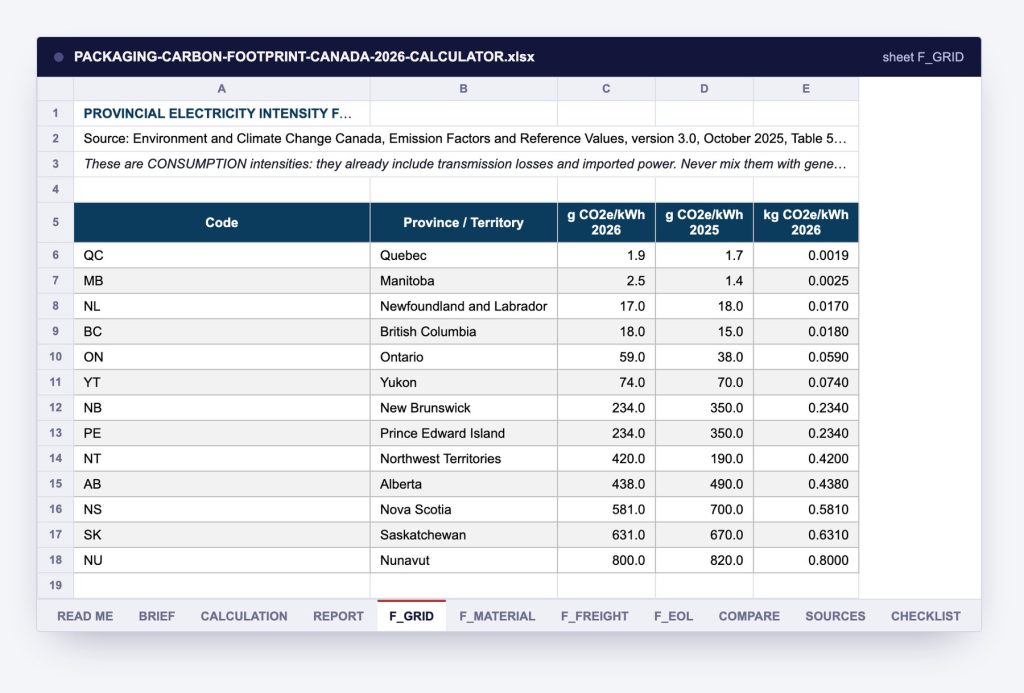
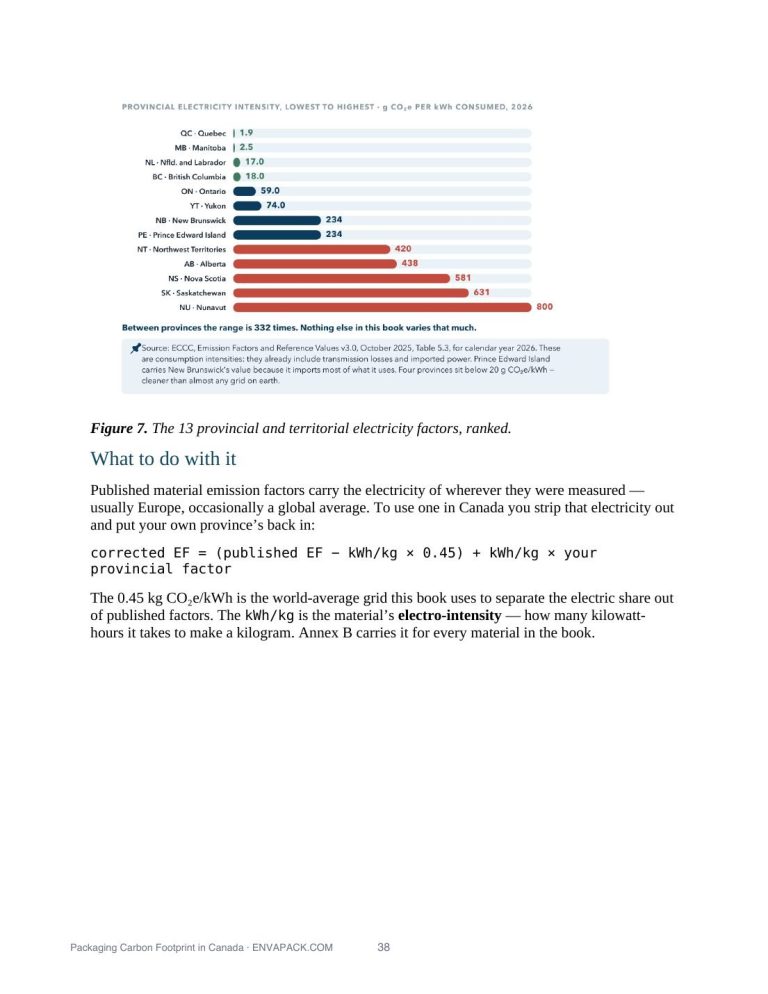
Quebec runs at 0.0019 kg CO₂e per kWh. Nunavut runs at 0.80. That is 420 times, on the same aluminum can.

$ 520,000 One-time payment. Instant download.

Buy the manualGet 10 free pages

El manual junto a la calculadora abierta en pantalla

Two orders of magnitude hide inside one country

Nowhere else does geography move a packaging footprint this much. A can body made in Quebec and the identical can body made in Saskatchewan are not the same product on a carbon ledger, and almost every number circulating in the Canadian market ignores it.

One volume in both languages, and a sheet to run it

The manual

292 pages · English and French · PDF and EPUB

The complete book twice over, in both official languages, inside a single volume. Six parts that go from the vocabulary to a signed report, with the Canadian regime built in rather than bolted on.

  • 31 chapters plus 4 working annexes and 6 technical annexes
  • 31 illustrations in each language, not shared between them
  • Bill C-59, the Federal Plastics Registry, provincial EPR and industrial carbon pricing
  • The calculation file: the twelve pieces that make a number defensible

The calculator

11 sheets · Excel with live formulas

Not a blank template: it ships with the factors loaded, a worked aluminum can example and the validations already set. You fill the yellow cells and the sheet computes materials, water, freight and end of life.

  • All 13 provincial and territorial factors, 2026 and 2025
  • 26 materials, each with a virgin and a recycled route
  • Location-based and market-based, with the caveat Canada forces
  • A three-design comparator, plus report and closing checklist

This is the calculator, from the inside

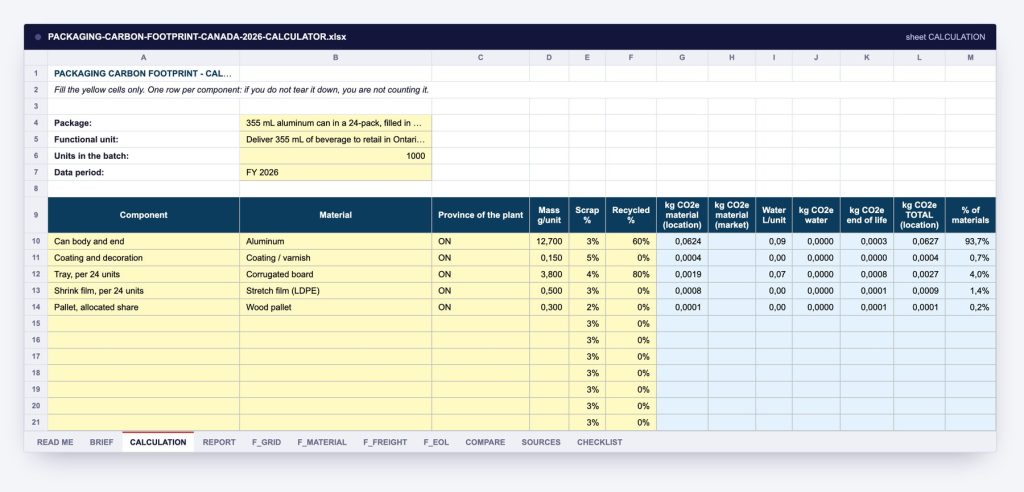
Yellow is what you fill. Blue is what the sheet computes. Nothing is hidden: open any formula and you can see where the number comes from.

The CALCULATION sheet with the worked example: an aluminum can made in Ontario, with its end, label and case.
The 13 provincial and territorial factors, ranked, from Quebec to Nunavut, with the year and the source.
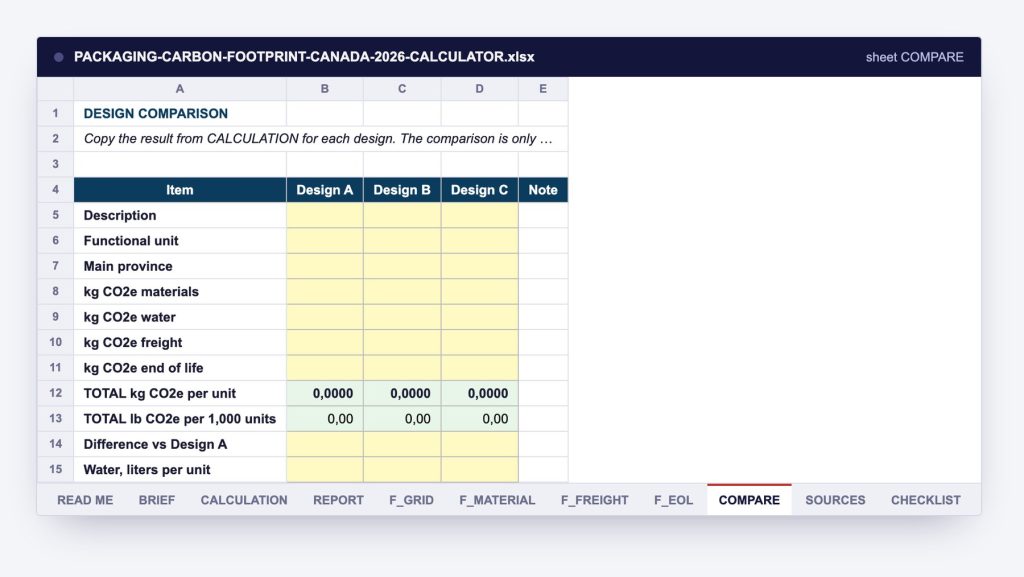
The comparator: three package designs, one method, and the difference as a percentage.
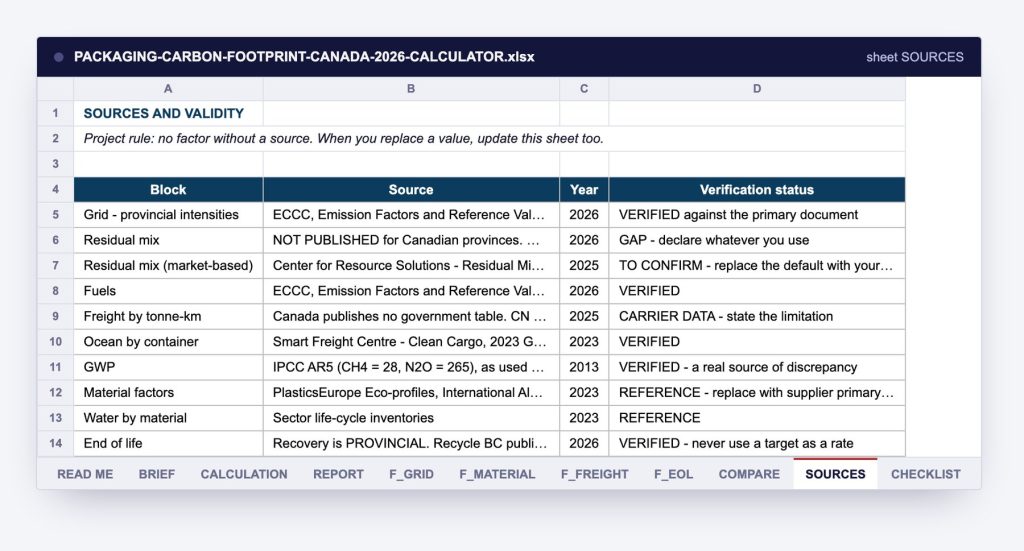
The SOURCES sheet: where every factor in the calculator comes from.

Move the plant and watch the number move

This is the actual formula from the book, running on the actual factors from the calculator. Change the province and you will see why this book exists.

30%

kg CO₂e per unit · materials only, before scrap

A run of 1,000 units
Cleanest province in the table
Most carbon-intensive
Gap between the two

That is the whole point: The full calculator also handles water, freight to your plant, end of life, the market-based method and the report.

Look inside

Real pages from the book, untouched.

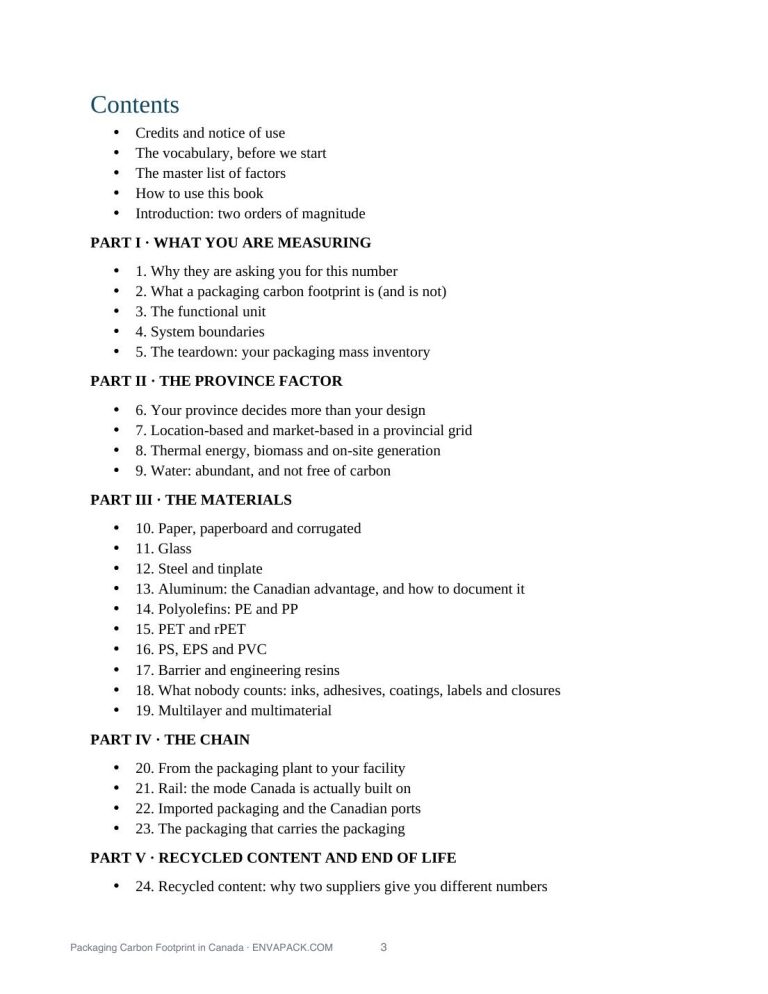
The full table of contents
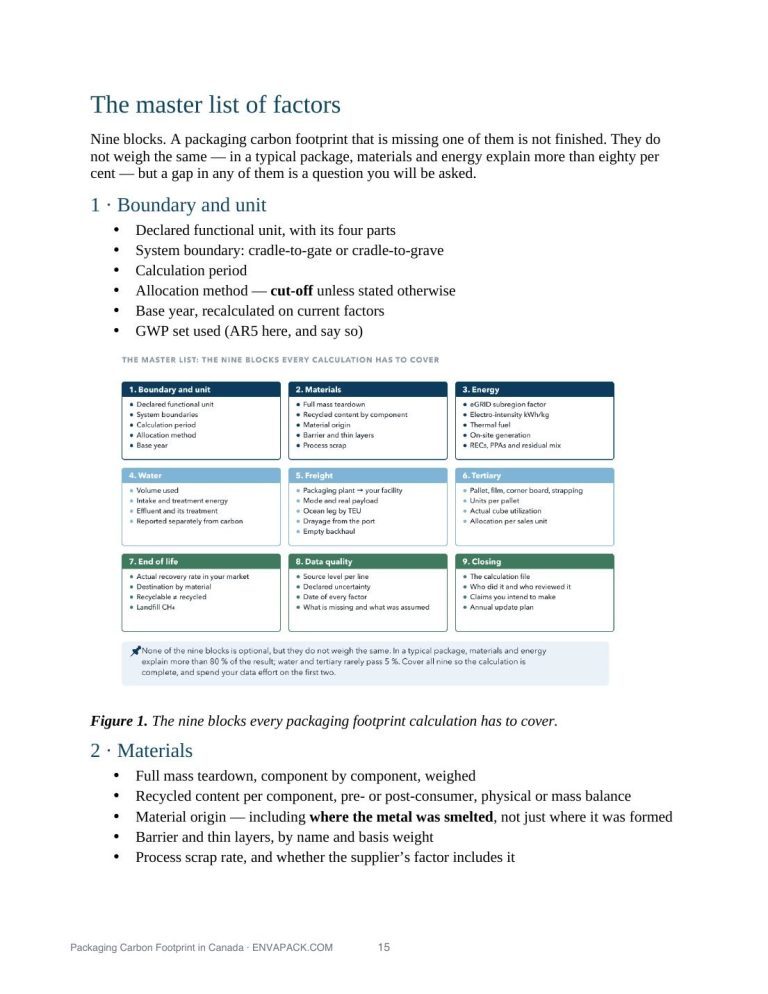
The master list of factors
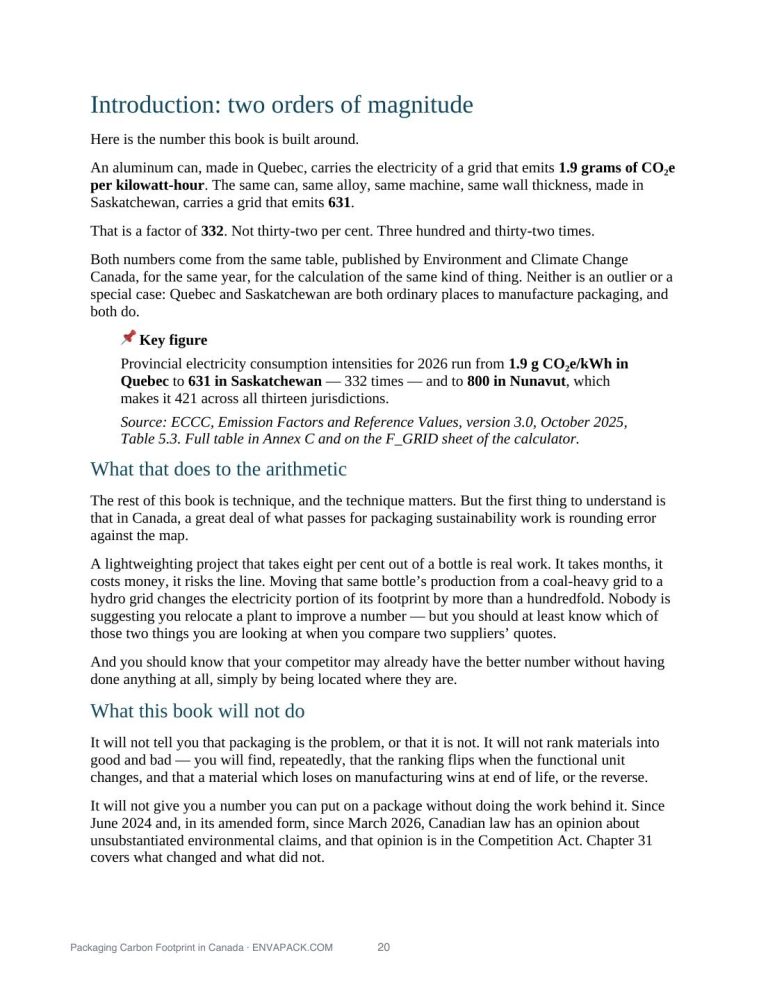
Introduction: two orders of magnitude
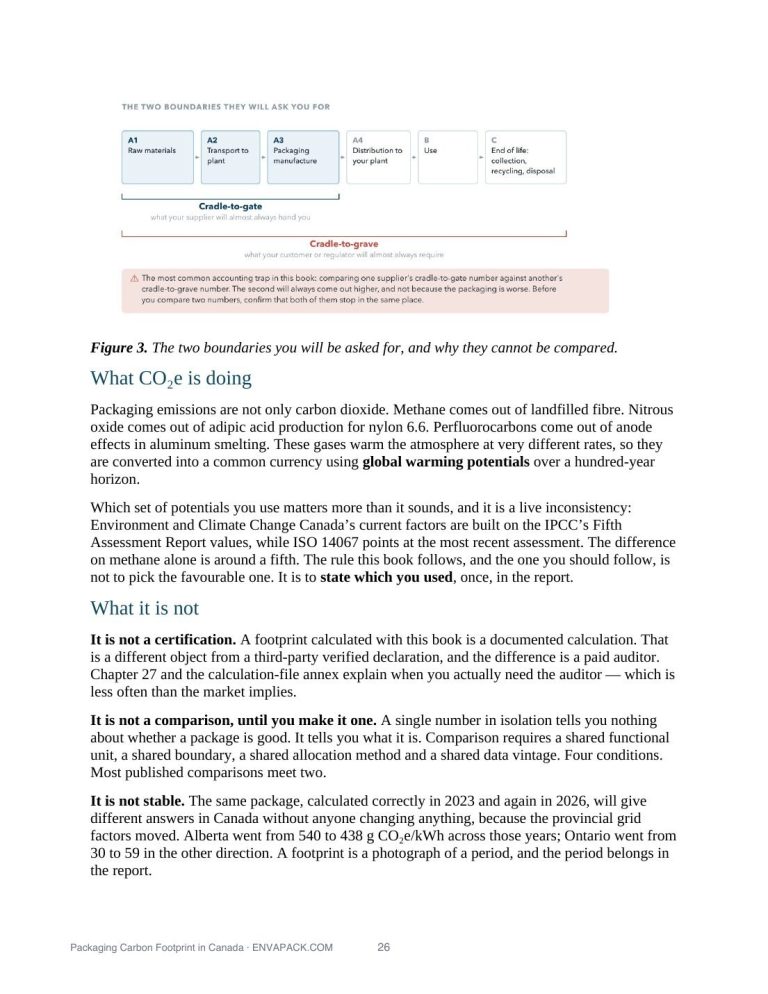
The two boundaries you will be asked for
The 13 provincial factors, ranked
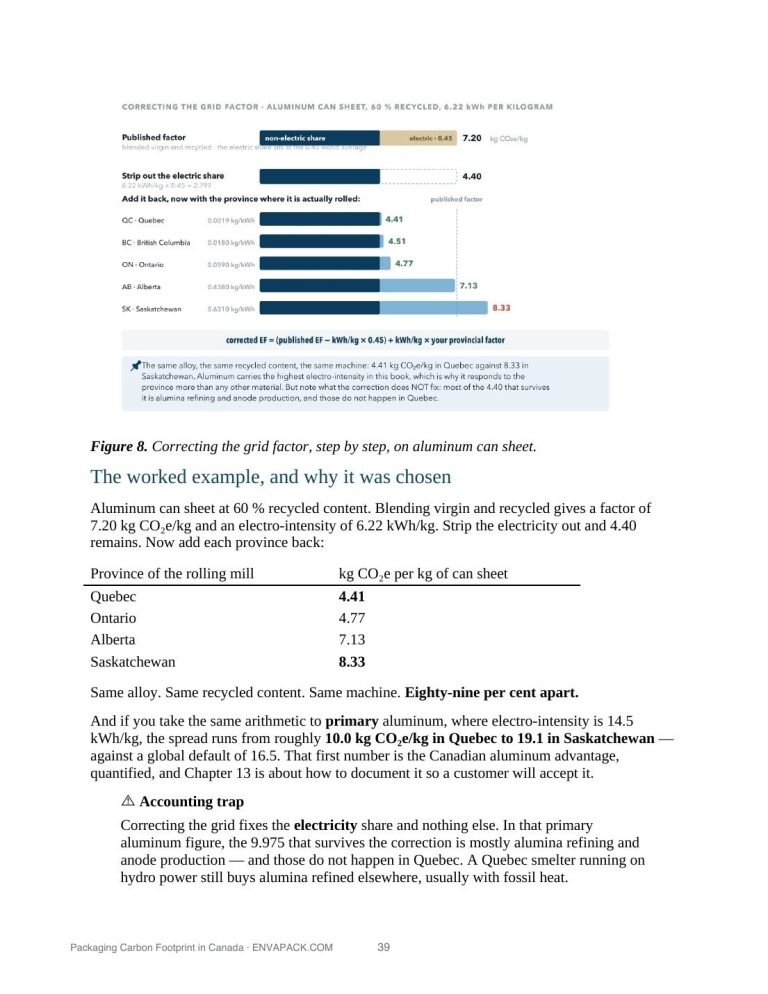
Correcting the grid factor, step by step

Take ten pages and decide

You do not have to take anyone’s word for it. We send you a real extract of the book, as a PDF, and you judge it yourself.

  • The cover and the full table of contents, chapter by chapter
  • The master list of factors: everything a defensible calculation has to define
  • The introduction, where the two orders of magnitude are laid out
  • The province chapter, with the ranked factors and a worked correction


    It arrives by email and appears right here. No spam: unsubscribe whenever you like.

    All 31 chapters, one by one

    Part I · What you are measuring 5
    1. Why they are asking you for this number
    2. What a packaging carbon footprint is (and is not)
    3. The functional unit
    4. System boundaries
    5. The teardown: your packaging mass inventory
    Part II · The province factor 4
    1. Your province decides more than your design
    2. Location-based and market-based in a provincial grid
    3. Thermal energy, biomass and on-site generation
    4. Water: abundant, and not free of carbon
    Part III · The materials 10
    1. Paper, paperboard and corrugated
    2. Glass
    3. Steel and tinplate
    4. Aluminum: the Canadian advantage, and how to document it
    5. Polyolefins: PE and PP
    6. PET and rPET
    7. PS, EPS and PVC
    8. Barrier and engineering resins
    9. What nobody counts: inks, adhesives, coatings, labels and closures
    10. Multilayer and multimaterial
    Part IV · The chain 4
    1. From the packaging plant to your facility
    2. Rail: the mode Canada is actually built on
    3. Imported packaging and the Canadian ports
    4. The packaging that carries the packaging
    Part V · Recycled content and end of life 3
    1. Recycled content: why two suppliers give you different numbers
    2. End of life province by province: EPR in Canada
    3. The Federal Plastics Registry and what it asks you to declare
    Part VI · From the number to the decision 5
    1. How good is your number
    2. Reducing for real
    3. Your carbon has a price: industrial carbon pricing
    4. Offsetting is not reducing
    5. Communicating under the Competition Act
    The ten annexes 10
    1. Working Annex · Intake brief
    2. Working Annex · Closing checklist
    3. Working Annex · The calculation file
    4. Annex · Certification and verification bodies
    5. Annex A · Applicable standards and regulation
    6. Annex B · Emission factors by material and route
    7. Annex C · Provincial electricity intensity factors
    8. Annex D · Water use by material
    9. Annex E · Freight: tonne-kilometre, rail, TEU and Canadian ports
    10. Annex F · Calculator manual, sheet by sheet

    Who this book is for

    Yes, this is for you

    • Packaging engineers and packaging managers, the people who end up having to answer the question.
    • R&D managers and directors who decide materials and structures.
    • Product managers who have to stand behind what the label says.
    • Procurement, quality, production and sustainability: anyone whose work touches the carbon footprint or the sustainability of the product.
    • Converters and packaging suppliers who need to answer with a number that holds up.

    Do not buy it if

    • Anyone looking for a general sustainability book: this is a calculation manual.
    • Anyone who needs water scarcity footprint: the book states plainly that it does not cover it.
    • Anyone expecting a certificate: this gets you to the calculation file, it does not replace a verifier.

    Every figure has a source you can open

    No number in this book comes from a licensed database you cannot check. Values are marked either verified against the official source, or a reference range where no official figure exists. The provincial factors come from Environment and Climate Change Canada, Emission Factors and Reference Values version 3.0, with the table and the year written next to them, and the book flags plainly that Canada publishes no official residual mix.

    Prof. Ing. Iván H. Rodríguez B.

    Who wrote it

    Prof. Ing. Iván H. Rodríguez B. has spent more than four decades in packaging, between the plant floor and the classroom, and runs Envapack.com. The book publishes no client cases, because there are confidentiality agreements in the way, but it does publish the patterns: the mistake he has seen most often, and what usually happens when a plant starts calculating too late.

    Frequently asked questions

    Is this one book or two?

    One volume with the complete text in both English and French, because that is how a document has to travel in Canada. You buy it once and you can hand either half to a customer, a regulator or a Quebec plant without commissioning a translation.

    What exactly do I get, and when?

    The full bilingual manual as PDF and EPUB, plus the 11-sheet Excel calculator. The download unlocks as soon as payment clears, on the same page and by email.

    Is the calculator in French too?

    Not yet. The calculator ships in English; the French edition of the spreadsheet is in preparation. The manual is complete in both languages, and Annex F documents the calculator sheet by sheet.

    Does it cover the Federal Plastics Registry?

    Yes, as its own chapter: what has to be declared, by whom and on what schedule, and how the packaging inventory you build in chapter 5 feeds it instead of being rebuilt from scratch.

    What about the Competition Act and green claims?

    Bill C-59 changed the rules for environmental claims in June 2024 and the closing chapter is written around it: which sentence you can put on a package, which one needs substantiation on an internationally recognised methodology, and which one now carries real exposure.

    What if my packaging is made outside Canada?

    The book carries import comparators and the freight chapter costs the journey to your plant, which covers most imported packaging. If the packaging is actually manufactured in the United States or in Latin America, we would point you to those manuals instead: the US volume works subregion by subregion on eGRID, and the Latin American one country by country across the region.

    Do I need an LCA background?

    No. The body is written for whoever makes packaging decisions from procurement, quality or operations. The technical annexes are there for the analyst who wants the detail.

    Start with your highest-volume package

    With the teardown in chapter 5 and the spreadsheet, you have your first defensible number in an afternoon.

    Buy the manual

    $ 520,000 · One-time payment. Instant download.

    $ 520,000 One-time payment. Instant download.

    Buy the manual