

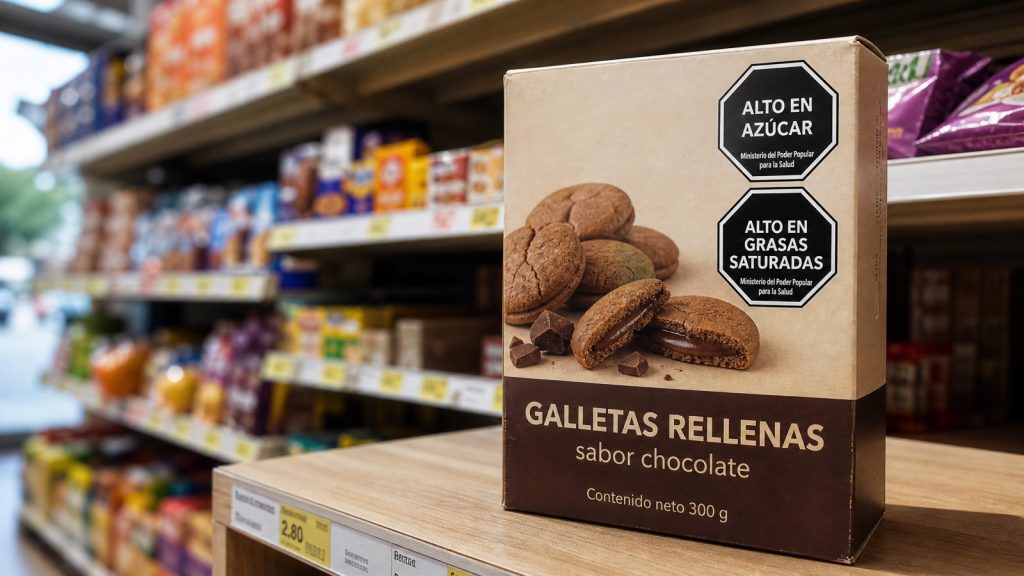
To sell packaged food in Venezuela, the label must be in Spanish and comply with standard COVENIN 2952: product name, brand, net content, CPE or CND code, ingredients with allergens, manufacturer and importer, sanitary registration number, lot, expiry date and nutrition information under COVENIN 2952-1. If the product exceeds the limits set by the Ministry of Health (MPPS), the front panel must also carry one or more black octagons: “ALTO EN SODIO”, “ALTO EN AZÚCAR”, “ALTO EN GRASAS SATURADAS” or “ALTO EN GRASAS TRANS”. Imported products whose label is not in Spanish need a supplementary sticker applied before sale.
Venezuela came late to front-of-pack warnings, but it adopted the same model as Chile, Peru and Colombia: a black octagon with white lettering. It did so in two steps, sodium first in 2020 and then sugar and fats in 2021, and both transition periods have now expired. At the same time, the general labeling standard, in force since 2001, is under review: in 2026 the standards body SENCAMER published the draft COVENIN 2952:2026. Anyone designing packaging for the Venezuelan market today has to keep an eye on both.
Table of contents
- The rules that govern the label
- The Ministry of Health octagons
- What the label must say
- Spanish is mandatory: supplementary stickers
- What changes with COVENIN 2952:2026
- Packaging checklist
- Frequently asked questions
- More from the series
- Sources
The rules that govern the label
- COVENIN 2952:2001, General standard for the labeling of prepackaged foods. This is the standard currently in force.
- Draft COVENIN 2952:2026 (2nd revision), released by SENCAMER for public consultation in August 2026. It will replace the 2001 version once approved.
- COVENIN 2952-1, on nutrition labeling and nutrition claims.
- MPPS Resolution No. 011 of January 17, 2020 (Official Gazette No. 41,804 of January 21, 2020), on labeling of foods high in sodium.
- MPPS Resolution No. 137 of December 2021 (Official Gazette No. 42,271 of December 7, 2021), on sugars, saturated fats and trans fats.
- Official Gazette No. 6,235 Extraordinary of June 7, 2016, which governs the Prepackaged Products Control (CPE) and Unequal Net Content (CND) codes issued by the metrology authority.
- COVENIN 5035:2024, for foods intended for people with celiac disease, if the product is labeled gluten-free.
The Ministry of Health octagons
Venezuela uses four warnings, not one, and they come from two separate resolutions. Thresholds are always calculated per 100 g or 100 ml, never per serving.
| Warning | Solids (per 100 g) | Liquids (per 100 ml) | Rule |
|---|---|---|---|
| ALTO EN SODIO (high in sodium) | ≥ 600 mg | ≥ 300 mg | Resolution 011/2020 |
| ALTO EN AZÚCAR (high in added sugars) | ≥ 11 g | ≥ 5.5 g | Resolution 137/2021 |
| ALTO EN GRASAS SATURADAS (high in saturated fat) | ≥ 5 g | ≥ 3 g | Resolution 137/2021 |
| ALTO EN GRASAS TRANS (high in trans fat) | > 0 g | > 0 g | Resolution 137/2021 |
What the seal must look like under Resolution 137:
- Black octagon with a white border, on the front of the label.
- The words “ALTO EN” with the nutrient below, in bold Arial, uppercase, white.
- At the bottom, the legend “Ministerio del Poder Popular para la Salud”.
- Pure black in print: C 0%, M 0%, Y 0%, K 100%.
- When more than one seal applies, the order is sugar, saturated fat, trans fat and sodium.
- It must be visible under normal conditions of purchase and use and cannot be covered, fully or partially.
The resolution also sets the proportions of the symbol and its placement when a product carries more than one label.
For sodium, Resolution 011 excludes edible salt and sodium-based additives sold as such. The seal applies to foods with added salt, or with an additive or ingredient containing sodium.
Deadlines: the grace period is over
Resolution 011 gave industry 24 months, which ran out in January 2022; the first “ALTO EN SODIO” seals reached store shelves in May that year. Resolution 137 gave 36 months from December 7, 2021, a deadline that passed in December 2024. Returnable containers had a five-year window. In 2026, any new product entering the market must carry the seals from the first batch.
Stickers: for imports only
Adhesive stickers with the octagon are allowed only on imported products packaged for the end consumer. Domestic manufacturers must print the seal on the package. And importers do not need a sticker if the product already carries, in Spanish, a warning for high content of that nutrient.
This matters for exporters coming from countries with similar octagons. Venezuelan thresholds do not match those of Peru (400 mg of sodium and 10 g of sugar per 100 g), Chile or Colombia, so a product may need a seal in one country and not in another. Artwork has to be checked against the Venezuelan table, not the one from the country of origin.
What the label must say
COVENIN 2952 splits the information between two areas of the package.
On the principal display panel:
- Name of the food, specific or descriptive. A brand or fanciful name may accompany it, but never replace it. Under the 2026 draft, the letters of the name must be at least 1/6 the height of the largest text on the label and never smaller than 2 mm, except on panels under 16 cm².
- Brand, where there is one.
- Net content in International System units: mass for solids, volume for liquids. Products sold by count declare the number of units plus the mass or volume.
- CPE or CND code, assigned by the metrology authority and printed indelibly.
- The octagons, where they apply.
On the information panel:
- Ingredient list, headed by the word “Ingredientes” and in descending order of weight.
- Allergens: cereals containing gluten, crustaceans, egg, fish, peanut, soy, milk and tree nuts must always be declared. Where cross-contact may occur during processing, a precautionary statement such as “Puede contener” (may contain) is required.
- Manufacturer’s name and full physical address, including street, warehouse or unit, city and state. If the packer is a different company, it must also be identified.
- For imports: country of origin and the importer’s name and address.
- Sanitary registration number.
- Lot, visible, legible and indelible.
- Expiry date or best-before date. Not required for salt, granulated sugar, vinegars or alcoholic beverages of 10% ABV or more.
- Storage conditions and directions for use, where the product requires them.
- Nutrition information, under COVENIN 2952-1. Not mandatory for industrial or institutional products.
Products made in Venezuela must also state “Hecho en la República Bolivariana de Venezuela” or “Envasado en la República Bolivariana de Venezuela”.
Spanish is mandatory: supplementary stickers
All mandatory text must appear in Spanish. If the original package is in another language, the standard requires a supplementary label (marbete) carrying the mandatory information, placed where it does not hide other mandatory information and attached to the product before it is sold.
For packaging design, that means leaving clear space on the information panel. A sticker placed over the nutrition table, the lot code or the octagons turns a legal fix into a violation.
What changes with COVENIN 2952:2026
SENCAMER’s draft keeps the logic of the standard but updates several points that affect design:
- Minimum size of the food name: 1/6 of the most prominent text, with a 2 mm floor.
- Full physical address: the city alone is no longer enough; street or avenue, plot, warehouse or unit, city and state are required for manufacturer, packer and importer.
- Visual consistency across pack sizes: colors, images and typography must stay consistent across the different sizes of the same product, with variations only to fit the text.
- Explicit reference to the CPE/CND code within the labeling standard.
- Graphic front-of-pack nutrition labeling allowed on a voluntary basis, based on daily reference values.
- Clear exclusions: it does not apply to products intended for export, foods packed in front of the consumer, or ready-to-eat foods prepared in restaurants and bakeries.
At the time of writing, the document available from SENCAMER is the draft. Until it is published as an official standard, COVENIN 2952:2001 applies, but packaging that already meets the draft will not need a redesign when it takes effect.
Packaging checklist
- All mandatory text in Spanish, or a supplementary sticker that covers nothing.
- Descriptive food name at the minimum height.
- Net content in SI units and CPE or CND code.
- Ingredients in descending order and allergens declared.
- Manufacturer with full address; importer and country of origin for imports.
- Sanitary registration number.
- Lot and expiry date.
- Nutrition table under COVENIN 2952-1.
- Sodium, added sugars, saturated and trans fat calculated per 100 g or 100 ml against the Venezuelan thresholds.
- Octagons in K 100% black, on the front, in the correct order and with nothing on top.
- Stickers only if the product is imported.
Frequently asked questions
What language must a food label be in for Venezuela? Spanish. If the original package is in another language, a supplementary label with the mandatory text is applied before sale, without covering other mandatory information.
What are the octagon thresholds in Venezuela? Per 100 g of solid food: 600 mg of sodium, 11 g of added sugars and 5 g of saturated fat. Per 100 ml of liquid: 300 mg, 5.5 g and 3 g. Any amount of trans fat requires a seal.
Can the octagons be applied as stickers? Only if the product is imported and packaged for the end consumer. Domestic manufacturers must print them on the package.
Is COVENIN 2952:2001 still in force? Yes, until COVENIN 2952:2026 is approved and published as an official standard. The draft went to public consultation in 2026.
What is the CPE code? It is the Prepackaged Products Control registration code issued by the metrology authority. Products with variable net content use the CND code.
More from the series
Sources
- SENCAMER, Draft Standard COVENIN 2952:2026, General standard for the labeling of prepackaged foods (2nd revision): https://www.sencamer.gob.ve/wp-content/uploads/2026/08/PNCOVENIN-2952-2026.pdf
- SENCAMER, COVENIN 2952:2001 (library catalog): https://sigbs.sencamer.gob.ve/cgi-bin/koha/opac-retrieve-file.pl?id=71441c203e889e409bdfa138e6d39e3e
- Official Gazette No. 42,271, December 7, 2021 (MPPS Resolution 137): https://historico.tsj.gob.ve/gaceta/diciembre/7122021/7122021-6359.pdf
- UNEP/FAOLEX, Resolution 137 record: https://leap.unep.org/en/countries/ve/national-legislation/resolucion-no-137-resolucion-para-regular-el-etiquetado-de
- UNEP/FAOLEX, Resolution 011 record: https://leap.unep.org/en/countries/ve/national-legislation/resolucion-no-011-regula-el-etiquetado-y-consumo-de-alimentos
- CWV (cwv.com.ve), summary of Resolution 137 (in Spanish): https://www.cwv.com.ve/venezuela-ministerio-de-salud-emite-lineamientos-para-el-etiquetado-de-alimentos-que-contengan-azucar-y-grasas-saturadas-y-trans/
- MiradorSalud, analysis of Resolution 011 on sodium (in Spanish): https://miradorsalud.com/se-establecen-en-venezuela-los-sellos-de-advertencia-para-el-sodio-mientras-que-el-resto-del-etiquetado-nutricional-sigue-salado/
- SENCAMER, COVENIN 5035:2024 (foods for people with celiac disease): https://www.sencamer.gob.ve/wp-content/uploads/2024/04/PNVC-5035-2024.pdf