

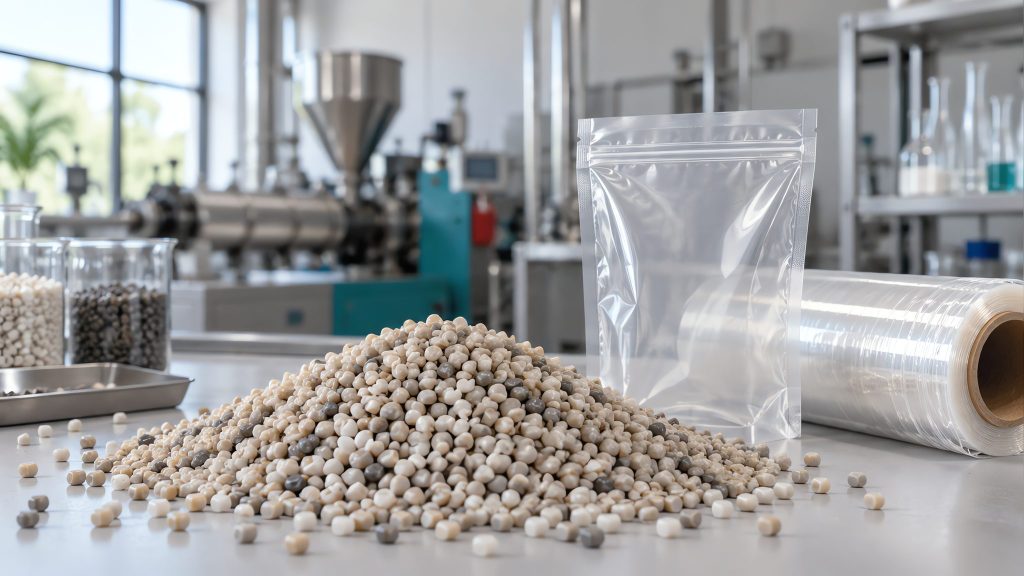
At Colombiaplast 2026, Dow laid out its circular plastics roadmap for the press: by 2035, everything it sells into packaging must be reusable or recyclable; by 2030, it aims to commercialize 500,000 metric tons a year of circular and renewable solutions; and by 2050, it intends to be carbon neutral. In Latin America, that strategy is already on the market as resins containing up to 100% post-consumer recycled plastic.
Bogotá, Colombia, September 30, 2026 –
Dow made the announcement on Wednesday, September 30, at a press breakfast held during Colombiaplast 2026, the plastics trade show that took place at Corferias in Bogotá from September 28 to October 2. Four company spokespeople took part: Leticia Jensen, Vice President of Plastics and Packaging for Latin America; Marcos Sato, Andean Commercial Director; Juan Diego Peña, Sustainability Manager; and Manuela Suárez, Development Engineer.
Dow by the Numbers: A Global Plastics Player
According to the figures the company brought to Colombiaplast 2026, Dow, headquartered in Midland, Michigan, has net sales of around USD 40 billion, roughly 35,000 employees and 98 manufacturing sites in 31 countries. Its largest operations are in the United States, Canada, Brazil, Argentina, Chile, Germany, the Netherlands, Spain, the United Kingdom, China and Thailand.
Dow has been in Latin America for more than 60 years. It employs over 3,000 people in the region and runs five regional offices: São Paulo, its Latin American headquarters, plus Buenos Aires, Santiago, Bogotá and Mexico City. It also operates the Latin America Inspiration Center in Jundiaí, Brazil.
In Colombia, the company has 60 employees, a polyurethane plant in Cartagena and an administrative office in Bogotá.
Latin America’s Polyethylene Market Is Growing Faster
Citing Dow Business Intelligence data, the company put the Latin American polyethylene (PE) market at about 9.2 million metric tons, with a compound annual growth rate of 2.6% between 2023 and 2028. The US and Canadian market is larger, at around 14.9 million metric tons, but is expanding more slowly: 2.4% a year over the same period.
The region, in other words, is still adding volume. And a large share of that polyethylene ends up in flexible and rigid packaging, the segment where recyclability and recycled-content requirements bite hardest.
Dow’s Sustainability Targets for 2030, 2035 and 2050
Dow frames its ambition around three commitments:
- Close the loop (2035). 100% of Dow products sold into packaging applications will be reusable or recyclable.
- Transform the waste (2030). Turn plastic waste and other alternative feedstocks into 500,000 metric tons a year of commercialized circular and renewable solutions.
- Protect the climate (2030 and 2050). Cut net annual carbon emissions by 5 million metric tons by 2030, a 15% reduction from its 2020 baseline and 30% from 2005. By 2050, Dow intends to be carbon neutral across Scopes 1, 2 and 3, including product benefits.
For Dow, the pace of decarbonization matters as much as the target. Its Scope 1 and 2 emissions stood at 35 million metric tons of CO₂ in 2020. Between 2005 and 2020 it cut them by about 15% while its ethylene capacity grew by around 30%, and it plans to repeat that pattern through 2030: another 15% less CO₂ with roughly 20% more volume. The remaining gap to 2050 will be closed with new technologies, phased in as the company renews its assets.
Those technologies fall into two groups. On carbon: a net-zero cracker with CO₂ capture, new cracking technology, nuclear and renewable energy, and electrification. On circularity: mechanical recycling, advanced recycling, bio-based feedstocks and design for recyclability.
Three Routes to Circular Resins
Dow is working along three pathways to bring circular content into its resins. Each suits different applications, and each has limits the company itself spelled out.
Mechanical Recycling and REVOLOOP™ Resins
This is the most widespread route: post-consumer plastic (PCR) is collected, washed and re-pelletized. It helps brands meet recycled-content goals or mandates and can lower the carbon footprint. It does come with two constraints: PCR may affect the properties of the final product, and food-contact options are limited.
Dow’s answer to the first is the REVOLOOP™ line: formulated, single-pellet resins that already contain certified PCR, so converters get consistent quality without having to do the blending themselves. Target applications include trash bags, stretch and shrink films, caps and closures, wire and cable, and roofing membranes.
Each grade comes out of a four-link collaboration. Recyclers supply the material; Dow’s materials science handles compatibilization, property enhancement and PCR analytics; Pack Studios develops the application; and the value chain (converters, equipment manufacturers, brand owners and retailers) takes it to market. The stated goal is recycled material that performs on par with virgin resin.
In Latin America, the REVOLOOP™ portfolio already has grades by country:
| Country | Grades | PCR content | Certification |
|---|---|---|---|
| Mexico | 4 translucent LDPE and LLDPE grades | 70–80% | Green Circle; RecyClass in process |
| Colombia | REVOLOOP 9237C (colored) and PCR LDPE XB 81810.44 (white) | 98% and 70% | Green Circle (9237C) |
| Brazil | White and colored HDPE; translucent LDPE and LLDPE | 95% (HDPE) and 70% | RecyClass |
| Argentina | LDPE, HDPE and several LLDPE grades | 70–100% | RecyClass / INTI on several grades |
Source: Dow, press presentation at Colombiaplast 2026.
These grades are already on store shelves. Dow showed commercial packaging with REVOLOOP™ content in all four countries: shrink films with 30% PCR in Mexico and Brazil; home care packaging with 20% and 30% PCR in Brazil; hygiene packaging with 30% and home care packaging with 20% in Colombia; and liners with 30% PCR in Argentina.
Advanced Recycling: From Plastic Waste to r-Naphtha
The second route targets plastic that mechanical recycling cannot handle. Waste is collected and sent to a sorting and pre-treatment facility; an advanced recycling process then converts it into pyrolysis oil. That oil is cleaned up into r-naphtha, which is fed into the cracker and comes out as polymer again.
Compared with mechanical recycling, the output performs like virgin resin and is food-contact compliant. It also reduces the use of fossil-based virgin plastic, allows material to be recycled repeatedly and opens an outlet for plastics that were not previously recycled. Other players are also working on food-grade recycled content, as Envapack reported on Interzero’s food-safe recyclates from household packaging.
Bio-Circular Polyethylene
The third route replaces part of the fossil feedstock with bio-based waste such as corn stover or used cooking oil. Dow stresses that these sources do not compete with food production and that the resulting resin matches fossil-based quality, with a potentially lower carbon footprint. The presentation illustrated this route with footwear and medical products, and with ENGAGE™ REN, its renewable polyolefin elastomers line.
The company also used the occasion to clear up a loosely used term. “Bioplastic” is an umbrella word: it can mean bio-based, biodegradable or both. Dow’s focus is bio-circular PE, a bio-based but non-biodegradable polyethylene that is recycled just like conventional PE. It belongs to a different family from PLA, PHA or PBAT.
How Circular Content Is Certified: ISCC PLUS Mass Balance
Advanced recycling and bio-circular feedstocks are accounted for through mass balance. Circular or bio-based feedstocks enter production alongside conventional ones; what comes out is a mix, but a proportion equal to the circular input can be sold as such. That share is certified by an independent third party under the ISCC PLUS (International Sustainability and Carbon Certification) scheme.
Because most Dow resin grades are available with this certification, the company says the bio-circular option fits almost any application: food packaging, industrial films, infrastructure and wire and cable, rigid packaging, transportation, pipe, hygiene and consumer goods.
Four Packaging Developments Dow Showcased at Colombiaplast
Dow’s technical team also presented concrete flexible and rigid packaging cases:
- Frozen food. Using INNATE™, ELITE™ and DOWLEX™ GM resins, a frozen vegetable bag gained impact resistance. According to Dow, the result was fewer breaks and punctures, and a package that keeps its integrity throughout the supply chain, exports included.
- All-PE stand-up pouch designed for recycling. A mono-material MDO/PE structure with ELITE™, ELITE™ AT, INNATE™ and AFFINITY™ replaces multilayer laminates containing PET or PP and opens the door to downgauging. Dow reports that it was validated across the value chain and performs well enough for commercial use.
- Pet food. A mono-material PE bag using MDO technology meets what this segment demands: puncture, tear and drop resistance, grease barrier, low dimpling, strong shelf appeal and hermetic seals. Dow says it performs on par with traditional structures and, unlike them, is recyclable.
- Lighter rigid packaging. With CONTINUUM™ bimodal HDPE and the Health+™ line, a bottle and its caps shed weight without losing strength during filling, transport and use. Less material per unit means lower cost and less CO₂ equivalent.
Packaging innovation of this kind has long been part of Dow’s playbook in the sector, as its Awards for Packaging Innovation, which reached their 30th edition in 2018, show.
What It Means for Latin America’s Packaging Industry
Dow’s presentation makes it clear that plastics circularity is being played out on several technologies at once. Mechanical recycling with formulated resins already covers a good part of films and bags. Advanced recycling and bio-circular feedstocks cover uses that require virgin-grade performance or food contact. And mono-material design gets packaging ready to be recycled at the end of its life. Other suppliers in the plastics value chain are pursuing similar goals, as Envapack covered in how Clariant is enabling circular plastic.
For converters and brand owners in the region, the task is to match each application with the right route before recycled-content requirements arrive. With certified grades already available in Colombia, Mexico, Brazil and Argentina, that decision now has concrete materials behind it.
Frequently Asked Questions
What is Dow REVOLOOP™?
REVOLOOP™ is Dow’s line of formulated, single-pellet resins that incorporate certified post-consumer recycled (PCR) plastic. In Latin America, grades with 70% to 100% PCR are available in Mexico, Colombia, Brazil and Argentina.
Which REVOLOOP™ grades are available in Colombia?
According to Dow’s presentation, Colombia has REVOLOOP 9237C, a colored grade with 98% PCR and Green Circle certification, and PCR LDPE XB 81810.44, a white grade with 70% PCR.
What is the difference between mechanical and advanced recycling?
Mechanical recycling washes and re-pelletizes plastic; it can affect properties and offers limited food-contact options. Advanced recycling converts waste into pyrolysis oil and then r-naphtha, which goes back into the cracker to make polymer with virgin-like performance that is suitable for food contact.
Is bio-circular polyethylene biodegradable?
No. It is a bio-based polyethylene made from waste such as corn stover or used cooking oil, but it does not biodegrade: it is recycled just like conventional polyethylene.
What are Dow’s sustainability targets?
By 2035, 100% of its packaging products will be reusable or recyclable. By 2030, it aims to commercialize 500,000 metric tons a year of circular and renewable solutions and to cut net carbon emissions by 5 million metric tons. By 2050, it intends to be carbon neutral.